OpenAttentionOne Percent Is Enough with Tail Proxies
(86.30 vs 87.04, RULER-32K HARD)
(OpenAttention.flash, 1% read, batch 32)
(52.2 → 11.4 ms/token, batch 1, H100)
Demo: same GPU, same model, 1% of the reads
Llama-3.1-8B-Instruct generating from a 30,012-token document on one H100, batch 1.
Left: Hugging Face dense attention out of the box (default SDPA backend, eager). Right: the deployed
OpenAttention decode path (1% total read, fused Triton selection, one CUDA graph per step).
Recorded in real time with demo/record_demo.py; both runs stream tokens with one host
sync per token, exactly as a server would.
Method in one minute
The problem: what happens to the unread tail?
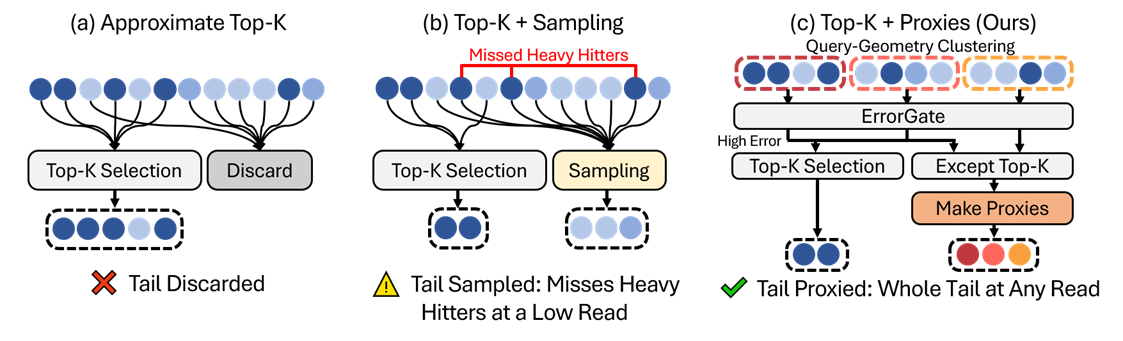
Two findings drive the design. First, the simplest possible proxy — one token folding the entire tail into its count-aware mean — already yields lower output error than a sample at every read behind a practical selector. Second, in closed form, at low reads sampling nearly doubles the weight error of discarding while a single proxy stays below it.
The pipeline
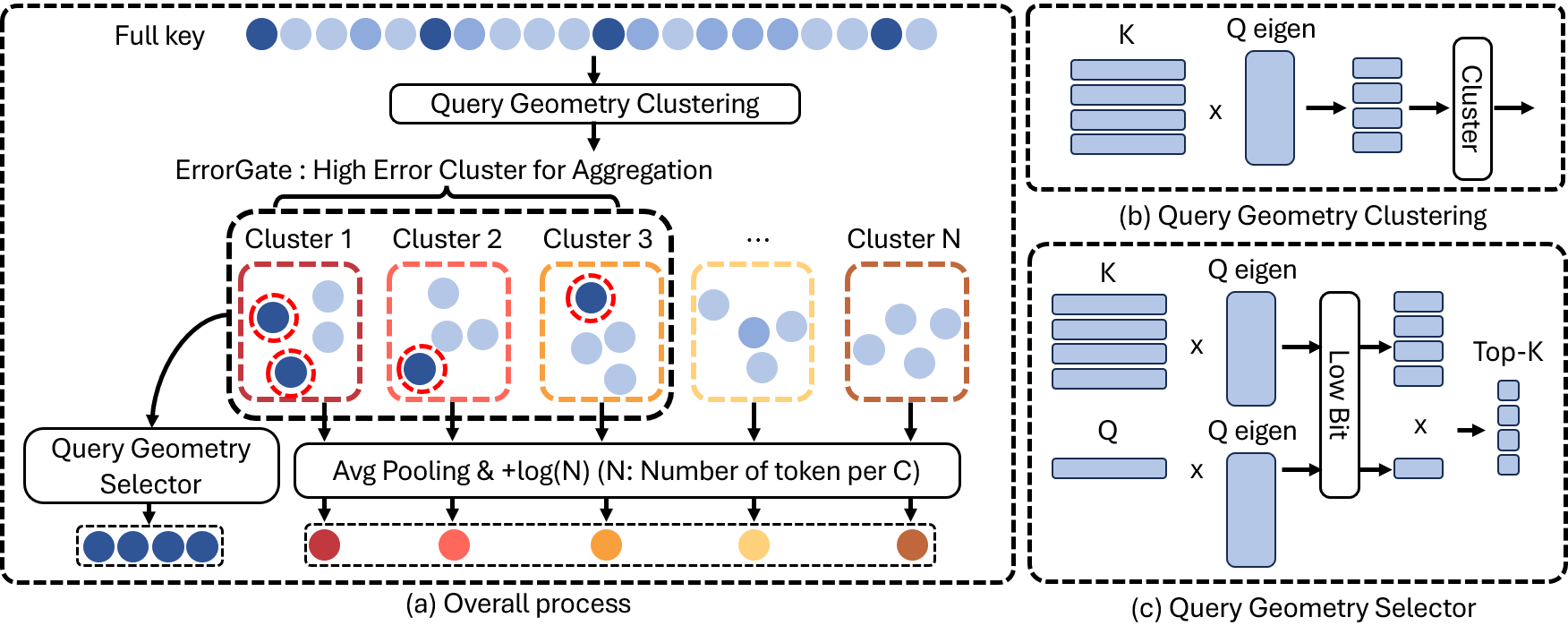
- QGC — Query-Geometry Clustering. Keys are clustered once per prefill in a rank-16 projection aligned with the directions queries actually probe (the top eigenvectors of M = ½Mst + ½Mq). Training-free; the static metric Mst is measured once on 18 held-out requests.
- QGS — Query-Geometry Selector. Each step scans rank-32 int8 key codes in the same geometry and takes the top-k. No learned hash functions, no per-model training.
- ErrorGate. Each cluster caches count, mean and diagonal-variance statistics. ErrorGate estimates each cluster's softmax-weight error and allocates the exact-read budget by water-filling — unlike prior methods that rank clusters by centroid score alone.
- Count-aware proxies. Every token still unread joins its cluster's proxy with logit z̄b + log nb and the mean value, keeping the softmax mass-preserving.
- OpenAttention.flash. A fused Triton kernel computes selected tokens, expanded tokens and proxies in one online-softmax pass.
Accuracy at matched total reads
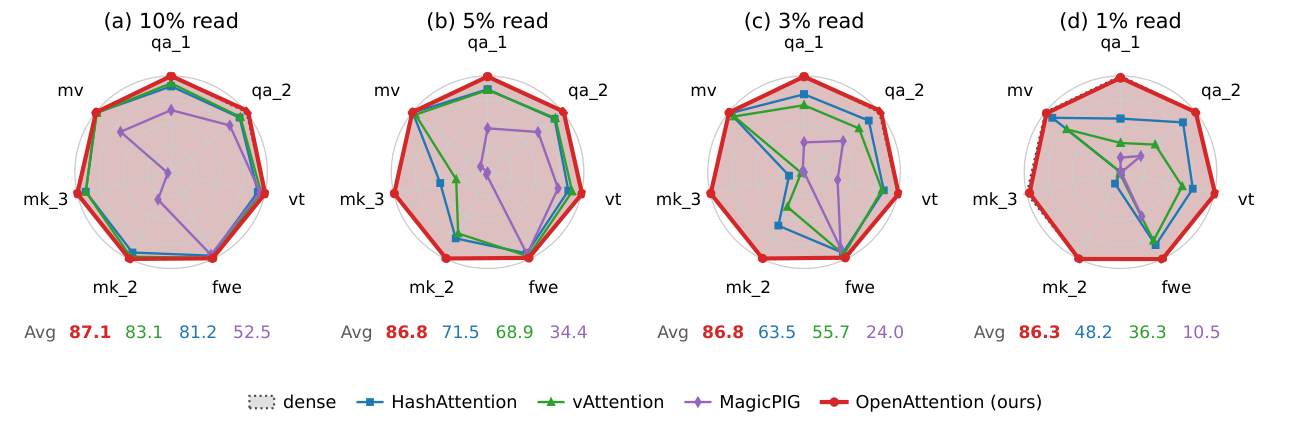
RULER-32K HARD (qa_1, qa_2, vt, fwe, niah_multikey_2/3, niah_multivalue; 200 requests each), Llama-3.1-8B-Instruct. Every stream a method reads is charged against its budget, including OpenAttention's proxy statistics. Dense attention scores 87.04.
| Total read | MagicPIG | HashAttention | vAttention | OpenAttention |
|---|---|---|---|---|
| 100% (dense) | — | — | — | 87.04 |
| 10% | 52.52 | 81.23 | 83.08 | 87.08 |
| 5% | 34.42 | 71.55 | 68.86 | 86.82 |
| 3% | 24.01 | 63.48 | 55.74 | 86.83 |
| 1% | 10.53 | 48.22 | 36.29 | 86.30 |
Speed
Attention stage (ms per layer, 32K context, batch 32)
| Budget | dense SDPA | OpenAttention (PyTorch) | OpenAttention.flash |
|---|---|---|---|
| 1% | 1.196 | 0.463 | 0.114 |
| 3% | 1.194 | 1.260 | 0.233 |
End to end (real 30K-token prompt, prefill + 128 decode steps, one H100, batch 1)
| ms/token | end-to-end s | |
|---|---|---|
| dense, HF default (SDPA→cuDNN, eager) | 52.2 | 8.33 |
| dense, SDPA FlashAttention backend | 17.6 | 3.89 |
| OpenAttention 1% (CUDA graph) | 11.4 | 3.19 |
The deployed path runs the full pipeline (QGC + QGS + ErrorGate + proxies) as sparse GPU kernels with one CUDA graph per decode step, and reproduces the paper accuracy within one standard error (86.30 at a 1% read vs 87.04 dense). The attention-stage advantage above grows with batch size and context length.
BibTeX
@article{yu2026openattention,
title = {OpenAttention: One Percent Is Enough with Tail Proxies},
author = {Yu, Hyunwoo and Lee, Jongbeom and Kim, Hyunbin and Park, Sungjun and Choi, Jaemin and Yang, Jincheol and Moon, Seunghun and Hyun, Bongjoon and Sohn, Kyomin and Kong, Kyeongbo and Kang, Suk-Ju},
journal = {arXiv preprint arXiv:2610.30951},
year = {2026}
}